Wednesday, September 26, 2007

Sui Genius


This Just In: Peter Cole Wins MacArthur "Genius" Grant

Very good start to year! Peter Cole, whom we've mentioned here many a time before, has won a MacArthur. Evidently he got the call just before the Hi-Hos. Gives a whole new meaning to that Leonard Cohen line: "and who / shall I say / is calling?"

Here's the official announcement off the MacArthur website:

Peter Cole is a translator, publisher, and poet who brings the often overlooked works of medieval Spain and the modern Middle East to English-speaking audiences. His highly regarded translations of the poetry of Solomon Ibn Gabirol and Shmuel HaNagid, two of the great Hebrew poets of the Andalusian “Golden Age,” offer readers a lyrical illustration of the extraordinary Arab-Jewish cultural partnership that flourished in tenth- through twelfth-century Spain. A poet himself, Cole’s translations infuse medieval verse with contemporary meaning while remaining faithful to the original text. His renderings of HaNagid’s poems in particular, long regarded as “untranslatable,” retain the subtleties, complexities, and formal elegance of the original verse. Underlying Cole’s translations is an implicit message of cultural and historical cross-fertilization that is also evident in his work as a poet and a publisher. His Ibis Editions publishes little-known works translated from Arabic, Hebrew, German, French, and Ladino, enlightening English-speaking audiences to the thriving literary tradition of the Levant. By fostering literary dialogue in and about the Middle East, Ibis provides an occasion for intellectual and cultural collaboration. In a region mired in conflict, Cole’s dedication to the literature of the Levant offers a unique and inspiring vision of the cultural, religious, and linguistic interactions that were and are possible among the peoples of the Middle East.

In your honor, Peter, this--if only because it started running through my head the minute I heard the news. Hats off!


Tuesday, September 25, 2007

After the Flood

My Jewish home base, the Jewish Reconstructionist Congregation, has been in temporary digs for about a year now, while our new building gets built. Our library was boxed up and put into storage--and, sadly, during the storms that marked this summer here in Chicago, most of the library was destroyed. (Who by water? Now we know.)

Our librarian has asked me to give her a wish list for the poetry section, and for the library more generally: anthologies, single author texts, works of criticism, you name it. I'm passing the question along to you, my colleagues and friends. In the best of all possible worlds, what should we buy? In this world, what should our priorities be?

I'll post my own list as I draw it up--but I'm eager to see what your lists would look like, so send them along, one by one, two by two, or by the dozens!

To thank you (in advance), this, by the Idan Raichel Project:


Out of the depths...

Wednesday, September 19, 2007

More announcements

In the spirit of Eric's announcement of Maeera's book (which I'll be reviewing for American Literature), folks might be interested in a couple of other new items. The first is perhaps not news to most people here, but just in case: Jerry Rothenberg's Triptych, just out from New Directions, with brief intro by Charles Bernstein and brief postface by Jerry. The book reissues Poland/1931 and Khurbn, and juxtaposes them with a new serial poem, "The Burning Babe." The second item is a scholarly article that perhaps fewer of us are likely to run across: Eric Hoffman, "A Poetry of Action: George Oppen and Communism," American Communist History 6.1 (2007): 1-28. The second half of the title pretty much tells you what it's about; among other things, it makes extensive use of previously unavailable FBI files.

Sunday, August 19, 2007

Maeera's Book (at Last!)


I can't (won't) tell you how long I've been waiting to make this announcement:

Singing in a Strange Land: A Jewish American Poetics, by our own Maeera Shreiber, is now available from Stanford University Press.

Here's the official description:
This book begins with a silence. While Jewish American fiction has long been recognized as a fit subject for critical inquiry, Jewish American poetry has largely been overlooked. Recently, a few books have started to redress this silence, focusing on some specific Jewish American poets. However, even as these studies begin to identify specific individuals as “Jewish American poets,” the field must be theorized so that we might understand this fascinating occlusion. Poetic forms need to be identified; and the material difference of Jewish cultural practice must be taken into account.

Taking a broad view of the subject, Singing in a Strange Land asks: How does being Jewish-in-America affect poetic production? And how does poetry help shape Jewish American identity? Beginning with a historical inquiry into the status of Jewish poetry as a marginalized kind of writing, and moving on to detailed analyses of poets including Allen Ginsberg, Adrienne Rich, Louis Zukofsky, Louise Glück, George Oppen, and Allen Grossman, Singing in a Strange Land helps us think about the ways in which displacement, exile, mourning, gender, and prayer contribute to the shaping of the Jewish American imagination and its poetic production.
We have only a handful of books on Jewish American poetry, and Maeera's bids fair to be essential reading. Let's all get copies and get talking about it here, shall we?

Friday, August 17, 2007

But Seriously, Folks...

--about what Alecia calls "living in the blur," the space between "secular" and "religious":

1) It seems to me that these terms, both Latinate, both based on Christian norms, fail to get at something essential in Jewish, or at least Jewish American, identity. I don't have a copy handy of Daniel Boyarin's brilliant Border Lines: the Partition of Judeo-Christianity, but his argument that our very notion of "religion" as a category was invented as part of the invention of Christianity in late antiquity struck me as well-founded and convincing. So did his even more intriguing case that this idea ("religion" as a category) was entertained but finally rejected by the men who created and eventually imposed rabbinic Judaism as a norm.

2) As a result, the identity documents we Jews have in our pockets ("your papers, please!") are a palimpsest of conflicting and competing terminology. This means, at least to say for us as 21st century American Jews, that they contain a palimpsest of options. Some are "religious," some national, some ethnic, some cultural; some are imposed from outside ("are you a member of The Jewish Faith?"; "how does it feel to be a Question?"; "must you mow your lawn on Shabbos?"), others from within, and others not imposed at all. "Secular observant Jew" is an entirely possible category. Arguments within the self are, therefore, commonplace.

3) Without speaking for anyone else, I'll testify that my own place on a "religious / secular" continuum has shifted many times. On reflection, I'd have to say that this motion has never, never been the result of reason, argument, or anything a Christian would call "faith" or "belief" or the loss thereof. It's all about mood, social context, family dynamics, the vagaries of my literary, professional, or sexual life. (Among the varieties of religious experience, James forgot to mention summer camp kisses--but at 14, they were Sinai, Horeb, a still, small voice all in one. I got your column of fire, baby, right here! "Arise my love, my fair one, and come away": all the rest is commentary. Go and study it.)

4) I live, now, in a neighborhood filled with "religious"--which is to say, shomer shabbos, Jews. I live on the fringes of that world, and must always do so: intermarriage will do that to you, as I've learned. Were I to learn enough Hebrew to chat with my thoroughly secular Israeli neighbors in the schoolyard, or enough Yiddish to chat with the ghosts of their grandparents, or enough Russian to chat with the architect-turned-custodian at my synagogue, I could see their religion and raise them a language. Maybe some day I'll do that, if the mood strikes--or maybe I'll start going to shul with my kids every week. None of that will make me be more or less Jewish, more or less a Jew; it would be about action, rather than ontology.

5) A proposition: The real divide today isn't between "religious" and "secular" Jews, but between ardent, ambivalent, and anti-Zionist Jews. That's where the rubber bullet hits the road. Case in point: the "conservative / reconstructionist" synagogue a couple of blocks from me, the one I could walk to, if I chose, has as the final topic in its conversion-class syllabus a history of the State of Israel. "Palestinians: No 'Right' of Return," one bullet point reads. My own politics are ill-informed and amateurish, but I'm struck here that this is one of the few "articles of faith" in the whole course. No shrimp, no Jesus, no Right of Return, and we don't really care about the shrimp.

6. In no particular order (from Siddur Kol Hevel):

“When he, too, who abhors the name, and believes himself to be godless, gives his whole being to addressing the Thou of his life, as a Thou that cannot be limited by another, he addresses God.”
--Martin Buber, I and Thou

"The human mind has all sorts of tricks of consciousness beside rationality, one of which is to address a projected part of the self or the universe as you, and both the 'simple' and the sophisticated take it as seriously as they need to on any given occasion." --Catherine Madsen, The Bones Reassemble


"All deities reside in the human breast."

--William Blake, The Marriage of Heaven and Hell


For liturgy, God is always a moving target: we pray to him and get equivocal answers, or none; we ask to see his glory and are shown only his back. Any assertion we make of God's grace and mercy is at once undercut by the contingency of our daily experience. Any assumption we make of God's indifference or hostility is eclipsed by the appearance of mercy and grace in our lives. The declaration from the burning bush, ehyeh asher ehyeh ("I will be what I will be"), is a promise and a threat in equal measure, and hints at the simultaneous presence and absence of God at the other end of our prayers. Yet whether God is present or absent is not a final or even an answerable question, only a sort of spiritual brain-teaser by which our minds stay alert. With or without God, what is unequivocally present is the human other in need. --Catherine Madsen, The Bones Reassemble.

O einer, o keiner, o niemand, o du:

O one, o none, o no one, o you:

--Paul Celan, from “There Was Earth Inside Them” (Es war Erde in ihnen)

7) My own creed? Ani ma'amin b'emunah sh'leyma b'viat hamashgiach. I believe with perfect faith in the coming of the Kashrut inspector. Someone always shows up to check your work, stamp your papers, keep a watchful eye. But until then, as my son says: "Get your treif on!"


Wednesday, August 15, 2007

Der Judenfrage

Who is a Jew?

--No, Who's on first.

What is a Jew?

--Gesundheit!

How is a Jew?

--Fine, thanks! How are you?

Where is a Jew?

--Skokie, evidently.

Why is a Jew? Why, oh why, oh why?

--Because, because, because, because. Goodbye, goodbye, goodbye.

(Or, as we used to say in the '70s, "Jew is not a problem to be solved, but a reality to be experienced.")

Tuesday, August 14, 2007

La question juive (What is a Jew?)

Rabbi Eliza would always say, Which comes first, the egg or the idea? as a way to stop a conversation she felt was coming too soon to a conclusion. One very hot afternoon, Rabbi Omar asked Rabbi Eliza to trace the origins of her favorite maxim. “In a roundabout way,” Rabbi Eliza began, looking up from the passage she was studying, “it’s related, to Rabbi Yukel’s so-called Rule of the Index Finger: Don’t put all your chickens in one egg, which itself is a variant of the saying, attributed to Rabbi Raj, and which we chant on the first half moon of Winter, One egg is not the world. On hearing this, Rabbi Omar loudly protested, noting that several centuries before Rabbi Raj, Rabbi Not-Enough-Sand-in-Dessert-not-Enough-Water-in-the-Sea had insisted that the central question to ponder on nights-without-visible-rainbows is Which comes first the basket or the idea of the basket?. “Exactly,” Rabbi Eliza said with a triumphant laugh, “without baskets or eggs we would only have words and without words only mouths.”

Sunday, August 12, 2007

Ostriker, Terman and Halevi

Many thanks to Alicia Ostriker for her nice framing of a perpetual question, one which is particularly important in regard to Jewish poetry. Chances are that most of us are out there on the same limb, and maybe being out there is part of the answer, if indeed there really is an answer, or even needs to be.

Alicia's post has been on my mind while I've been reading Rabbis of the Air, a new book of poems by Philip Terman. In a recent e-mail, after we had exchanged books (yes friends, Passing Over is now available!), Phil spoke about his style in contrast to mine, given his commitment to "narrative structures, use of personal experience, memory," etc. Mine, especially in recent years, has been much more disjunctive in various ways. But be that as it may, there's poem in Rabbis of the Air which illustrates the problem that Alicia raises with admirable tact, poise, feeling and economy. It's called "A Response to Jehuda Halevi":

"Is it well that the dead shall be remembered,
And the Ark and the Tablets forgotten?"

Yes, Jehuda, I would rather recall
the business cards of my father's
used car lot than the five books

and all their commentaries, the recipe
for my grandmother's kuchin than
the Kabbalah and its interpretations,

her delicate matzo balls than all
of the much-sought-after mystical
masterpieces. I would rather discover

the dandruff of my dead friend's dark
hair than the inscribed stones Moses
bloodied his flesh--twice--to attain.

Because I am nothing without them,
whose words accent my speech,
whose motions choreograph my gestures--

dreamstuff are my dead, demanding
my devotion--yes, Jehuda,
it is well they shall be remembered,

their names the undertone whenever
my own name is called, their ghost-souls
more present than this corporeal furniture

of the world which, like the ark and tablets,
hold their form in bodies of beauty
then dissolve, indistinguisable from the dust.

Ordinarily I would have a lot of trouble with a poem in which the speaker invokes his grandmother's "delicate matzo balls," but in this case, the gamble with sentimentality pays off, given the strength of the ensuing stanzas. It's a poem that raises one of those big questions, as Alicia does, and it makes a lot of sense in the context of Halevi, whose devotional poetry carries such an erotic--i.e. profane--charge. Terman makes a powerful claim for cultural Jewishness over religious devotion here, in the name of the "ghost-souls" of his dead. For more along these lines, check out Rabbis of the Air.

Friday, August 03, 2007

What is a Jew Redux

Just recently chatting with Ken Gordon at JBooks on the question of Judaism and Modernism, or as he puts it, “Making Jews Modern,” it seems to me this is yet another variant of the perennial question, What Is a Jew. Is this a weird question? Christians don’t seem to ask “What is a Christian,” or at least they don’t ask it where I can hear it. On the other hand, many Afro-Americans do seem to hold the self-scrutinizing mirror up in a similar way, asking themselves Am I black enough? Am I too black? Is it a question of blood? Is it a question of culture, and if so, what culture?

For Jews, one crude dividing line has long been Religious (or Observant) versus Secular. Personally, I think these are leaky categories. I was a Red Diaper baby, or as I like to put it, a Third Generation Atheist Socialist Jew. My grandfather on one side stopped studying Talmud and started studying medicine; the grandfather on the other side was a disciple of Kropotkin; my father was a Union man and for a few years a Party member; my parents voted for Wallace when everybody else was voting for Truman. My Jewish education consisted of being told that religion was the opiate of the people and that Jews were in favor of education, tolerance, justice and kindness, and against poverty, war, ignorance and prejudice. Because Jews suffered, we were supposed to help anybody who was suffering.

Did my parents know that their passion for social justice was rooted in the Hebrew prophets Isaiah and Amos, or even further back, when we were commanded to love the stranger because we know the heart of the stranger, because we were strangers in Egypt? No. My parents never saw the inside of a shul, and they never read the Bible. When I became obsessed with writing midrash, in my late 40’s, my mother (in her ‘70’s) thought I was crazy. But in retrospect, the lineage is obvious. So the split between religious and secular Judaism is, as we say in academe, problematic.

Two books I’ve recently read touch on this, Esther Schor’s biography of the poet-essayist-journalist Emma Lazarus, and Rebecca Goldstein’s Betraying Spinoza.

I’ll condense a bit here from my review of Schor’s book, in Sh’ma:

Lazarus, born into an extremely wealthy and visible New York Sephardic family, was never “religious.” Throughout her life she pretended not to notice the genteel anti-Semitism of her elite literary and artistic colleagues and friends, while her own Jewishness grew increasingly intense as she matured. She translated medieval Sephardic poets, then Heine, and wrote a sharp essay about Heine’s conversion to Christianity, claiming that “no sooner was the irrevocable step taken than it was bitterly repented...as an unworthy concession to tyrannic injustice.” When anti-Semitism of a less genteel kind began to swell in Europe, she responded instantly. In her melodrama The Dance to Death, about massacre and martyrdom in fourteenth century Germany. viciousness is not underplayed.... Like other assimilated Jews of her class, Lazarus felt condescension for the “ghetto Jew” of Eastern Europe. But in the 1880’s, when floods of Russian Jews fleeing pogroms became a “problem” both for Christian America and for assimilated Jewry, Lazarus not only became a major player in the debate, unflinchingly attacking both Christian hypocrisy and Jewish complacency; she visited the refugees on Ward’s Island and elsewhere, advocated for sanitation, education and job training, published Songs of a Semite, and in a weekly column in the American Hebrew announced her vision of a secular Jewish state in Palestine—years before the word “Zionism” was invented. She also insisted on a new idea of America. “Every American,” she wrote in an unsigned essay, “must feel a thrill of pride and gratitude in the thought that his country is the refuge of the oppressed.”

Lazarus died at the age of 38, of Hodgkin’s disease. Her writing came to respect and quote prophets and rabbis. She is known today for her words on the pedestal of the Statue of Liberty. But Schor’s excellent biography makes clear that by the end of her life she “was inventing the role of an American Jewish writer” whose prophetic burden “was to glimpse, in the trials of her people, the pain of the world’s exiles, and in her own passionate vocation, a mission for her country.” This sense of mission is still felt by many Jews in the worlds of literature, art and journalism, not to mention the Jewish activists who still crowd every progressive organization and gathering, and for whom being Jewish means you side with the oppressed and against the oppressors.

One common type of Jewish activist, of course, doesn’t come out as “Jewish,” just as lefty. But what Isaac Deutscher called “the non-Jewish Jew” has a long lineage. Allen Ginsberg is perhaps the most significant recent avatar—somebody who hated being labelled as a Jew, and was conspicuously extremely Jewish. Goldstein calls her philosophical-cultural biography of Baruch Spinoza Betraying Spinoza because her project is to “out” him as the Jew he chose not to be. For Goldstein, the spiny Spinoza (his name means “thorn” in the Portuguese of the Amsterdam Jewish community in which he grew up) was among the inventors of modern philosophy, standing between Descartes and Leibniz as a proponent of Rationalism—one might say Extreme Rationalism, since for him the universe is itself composed of pure Reason. Her description of his writings is lucid, and to a philosophical novice like myself, fascinating. But her larger project is to show how his philosophy was shaped, despite his disavowal of contingency, precisely by the contingencies of history.

In 1656 at the age of 23 Spinoza was excommunicated by the Amsterdam Jewish elders, in a writ that accuses him of “abominable heresies” and “monstrous deeds,” curses him, and forbids other Jews to have any kind of contact with him. One can see why. He must have been a thorn in the side of a community of refugees from the Inquisition. His later monistic metaphysics emphatically rejects the concepts of a providential God, a chosen people, the Mosaic authorship of Torah, a personal afterlife, and much else that was essential to this community’s often turbulent efforts to define what a Jew was supposed to be and believe—including “belief” itself. Like Shakespeare’s Coriolanus who, when banished from Rome, retorts “I banish you!” and seeks “a world elsewhere,” Spinoza became the West’s first advocate of a purely secular state. More than that, he dismisses the significance of whatever interferes with Reason: family, race, religion, gender, nationality, are all irrelevant to Truth, all obstacles to the knowledge which is the proper goal of all human life.

Goldstein’s portrait of Amsterdam Jewry and its theological controversies in Spinoza’s time is rich and convincing. I confess that I enjoy learning that Jews were at least as contentious in the 17th century as they are now. She tracks the rationalism Spinoza inherits from Maimonides, as well as the “ecstatic impulse that irradiates kabbala;” both impulses were alive and well in Amsterdam, and both clearly charged his batteries. Somewhat less convincing is her attempt to portray Spinoza as enacting on a small scale the story of the persecuted and secretive Marronites in their attempt to forge a new identity for themselves What’s most fascinating, it seems to me, is that in Spinoza’s thought an absolutely rational secularism is identical with an absolutely impassioned amor dei intellectualis, the intellectual love of God. “The mind’s highest good is the knowledge of God, and the mind’s virtue is to know God,” he writes. He calls this knowledge “blessedness.” God is the infinite center of his thinking, and though his idea of God as immanent in all that exists isn’t what his fellow-Jews had in mind at all, it wouldn’t surprise me if many Jews today—both “religious” and “secular”—think something similar.

I’m recommending both these books. But I’m also curious what others think about the “religious” versus “secular” divide. Obviously the distinction is a useful first-order one. Some Jews are purely and faithfully observant, some are purely and faithfully atheist. But what about the areas of overlap? What about those of us who live in the blur? If I look at the table of contents of Rubin’s Telling and Remembering, or Barron and Selinger’s Jewish American Poetry, I’m wiling to bet that more than half the poets in these volumes live in the blur. What does that tell us? I think I m out on a limb here, and I hope others are there with me.

Alicia Ostriker


--.


Wednesday, July 18, 2007

Rockdale Lectures

Robert Murphy of Dos Madres Press has generously arranged to put recordings of the lectures I gave at Rockdale Temple in April on line here. The titles of the lectures are "Remembering and Forgetting in Jewish American Fiction" (including discussions of Daniel Fuchs, Bernard Malamud and Myla Goldberg) and "The Sacred, the Secular and the Book: The Problem of the Jewish Literary Imagination." In case you're looking for something to do before the new Harry Potter comes out (or once you're done with it), give a listen and let me know what you think.

Monday, July 02, 2007

Countdown to The Book We've Been Waiting For...


No, not Harry Potter. I mean the book--THE book--that I've long needed, about Zukofsky.

Let me explain.

Fifteen years ago, Mark Scroggins and I were neighbors, nearly. He lived in Reston, I in Arlington, VA: close enough to meet for coffee and to talk, though not often enough, about poetry. We both loved Ronald Johnson--that was how we met--but after that, our tastes diverged. I leaned to the right, professing a love of Merrill and Auden. For Mark, the touchstone was always Louis Zukofsky, on whom he'd written a dissertation back at Cornell.

I got Mark to take a second look at my favorites, but Zuk always eluded me: one of those poets I felt I ought to love, but for various reasons (never quite clear to me, I'll confess), never did. I needed a hook, somehow: a text or tale to have in mind when I read the poems themselves, as I have Susan Howe's and Charles Bernstein's essays when I turn to their work, or Rene Stenke's novel Holy Skirts when I read the Baroness Elsa von Freytag-Loringhoven.

And now it's here, or almost here:

Louis Zukofsky: The Poem of a Life
, by Mark Scroggins: a critical biography born (says Mark on his blog) from "7 or 8 years of grubbing in the archives (think Gandalf in the Minas Tirith scrolls basement, minus the pipe & tankard of ale), interviewing poets, writers, & folk of all walks of life from San Francisco to Edinburgh, and (mostly) bending over a legal pad or a word processor in a haze of tobacco smoke & caffeine."

I've read portions in draft: they're deftly written, critically subtle, and emotionally astute--in short, they're everything that I have needed to read Zukofsky for pleasure. To read him not least as a Jewish poet, let me add in these heimish confines.

For the last few years, we've all heard that Zukofsky was a crucial figure in twentieth-century American poetry, and still more in Jewish American poetry. This is the book, I reckon, that will clinch that case. I don't have the software handy to do a "countdown to publication" as they do for Harry P, but I'll be waiting for it to show up in my mailbox just as eagerly as my kids are waiting for HP & the Marshy Mallows. (Note to Mark: maybe you could photoshop a Z-shaped scar on L's forehead, just for the cover? He's got the glasses already!)

Thursday, June 21, 2007

Shameful Self-Promotion

Here's my review of Hettie Jones's DOING 70 as it appears in this week's FORWARD. To see it in the metaphoric flesh, go to www.forward.com/articles/10979/. While I'm at it, let me also plug my review of Kenneth Koch, also at the FORWARD:
www.forward.com/articles/taking-parnassus-by-sheer-force-of-wit/.


Doing 70
By Hettie Jones
Hanging Loose Press, 92 pages, $15.


It is hard to talk about Hettie Jones’s poetry without mentioning her biography. Born Hettie Cohen in 1934, brought up in a middle-class section of Queens, she decamped to Manhattan’s Greenwich Village in the mid-1950s. There she met and married the young black poet and soon-to-be playwright LeRoi Jones. In “How I Became Hettie Jones,” her remarkably level-headed 1990 memoir of that remarkably un-levelheaded period, Jones claims that she made this series of leaps because she was Jewish, although not in any conventional way. “As an outsider Jew I could have tried for white, aspired to the liberal intellectual, potentially conservative Western tradition,” she wrote. “But I was never drawn to that history and with so little to call my own, I felt free to choose.”

She chose New York’s Beat Bohemia and had quite a time. She became friends with poets (Allen Ginsberg and Frank O’Hara), with musicians (Ornette Coleman and Archie Shepp) and with painters (Franz Kline and Larry Rivers). As we know, this multi-hued downtown scene, so lovingly depicted in “How I Became Hettie Jones,” did not last. In the final analysis, it could not. The tensions of the early ’60s drove a thick racial wedge through the whole shebang — through her marriage as well as through a whole series of equally fragile alliances. LeRoi Jones became Amiri Baraka, but not before he left his wife and kids. And the rest, as they say, is history.

“How I Became Hettie Jones,” makes it clear that the complicated Beat paradise it describes was much more heavenly for the men than for the women. With a few exceptions, the guys were old-fashioned guys. They wrote, drank, smoked dope and screwed around, while their wives and girlfriends — all talented in their own right — earned the money and took care of the bills and looked after the kids. Occasionally they managed to screw around, as well, but only in their rare, free moments. The toll on their creativity was pretty high. While Hettie Jones did write a number of books for children and adults through the ’90s, she did not publish her first volume of poetry until she was over 60. She has made up for lost time “Doing 70” is her third in nine years. On the whole, Jones’s poems present fresh examples of a late ’50s/early ’60s aesthetic. To call them “Beat” does not do them justice, because they are happily devoid of the dated prophetic stances and the willful cuteness that you find in way too many works of the time. Nevertheless, she claims kin with the Beats. Her poetry mixes the everyday diction of William Carlos Williams with a capacious Zen openness. It tends to move swiftly from a concrete present to moments of glancing insight. Her poems usually start with mundane, very urban occurrences (getting towed, calling the plumber, meeting an acquaintance from the neighborhood in the street), only to end with expressions of unexpected joy.

Here is the end of “Genuflection to the Cable Guys From Time Warner,” which describes a rainy-day confrontation between two workmen who insist there is a cable box on the roof and an “undersized, overdressed/older white woman/in raveling fingerless gloves,” that is, the poet herself:

Genuflection in the house
to the cable guys
from Time Warner

who find nothing on the roof

and are laughing coming down

the one who says, oh, you have a nice apartment
and the one who reaches to shake my half-gloved hand

sweet meeting, these bare, wet fingers.

The poem concludes with that lovely second of contact between Jones and the workers. she describes all this with such lightness, such good humor that even the most informed reader might miss what I take to be an echo of Ezra Pound’s “In a Station of the Metro.” But perhaps you don’t actually need to notice it, because Jones’s refusal of Pound is so complete. She rejects Pound’s urban anomie, however pretty it might be, and substitutes in its place the odd recognitions and connections of city life.

This same insistence on human contact animates “Women in Black,” a brief account of a vigil in Beijing:

Patterns in the dust of
different kinds of shoe soles
black on black
we sway like grain, like the woman
beside me, the scar of the burning
she escaped

When she turns to me,
smiling, the scar is a path, slick
in the gathering dark Half the world
is ours to take.

This poem is not the best in the collection (the title poem takes that prize), but it definitely shows Jones at her best. She moves with deceptive ease from perception to simile and then to flat declaration. Jones is also very deft in her treatment of what becomes the central figure of that poem, the scar that marks the woman beside her. That scar seems to signal some untold story of violence, but Jones lets it rest as a simple fact. She avoids the temptations of melodrama and opts instead for the hope and the wit of the final line. Not only is Jones apparently free of rancor, but she also is possessed of what might be the greatest of political virtues: solidarity. She is able to relate without having to identify, to love without having to consume. This is a great gift, and, coupled with her resolute optimism, it is worth the price of admission.

Needless to say, not all the poetry in “Doing 70” is as successful as this. It is very hard to find a consistent balance between relatively slight motivations and resonant conclusions, especially in anti-war poems. So the book is uneven and sometimes the endings don’t work. That doesn’t matter. The strength of Jones’s work does not really rest on its best lines or its aptest metaphors or its most fitting closures. Instead, the poems serve as models of emotional engagement. Tough and sexy, they remain committed to the upstart possibilities of the postmodern city. Jones lacks illusion, but she is not disillusioned. That is no small thing, and may well be one of the gifts of age. She is, in the end, a mensch. It is usually mere irrelevance or pure sentimentality to talk about a poet’s heart. With Hettie Jones, it becomes a form of praise.


Tue. Jun 19, 2007

Friday, June 01, 2007

Summertime Jews

Ain't no cure, so you might as well enjoy them.


(Don't ask me why, but this sounded awfully summery to me.)

Tuesday, May 29, 2007

SKV #3

In a comment, Daniel suggests poem 50 from Cohen's Book of Mercy. I found it on line, so here it is!
I lost my way, I forgot to call on your name. The raw heart beat against the world, and the tears were for my lost victory. But you are here. You have always been here. The world is all forgetting, and the heart is a rage of directions, but your name unifies the heart, and the world is lifted into its place. Blessed is the one who waits in the traveller's heart for his turning.
I do love that last line. There are others in the sequence that hit me harder, maybe because this one is more purely consoling by the close. I wonder: might Cohen's "here" gloss the Hebrew "haMakom," as in the Passover song? (Baruch haMakom, Baruch who? Baruch Shenatan, natan Torah....)

(A typo above, but I think I'll keep it. I like the ha-Hu as a Who.)

Peter Cole's New Anthology


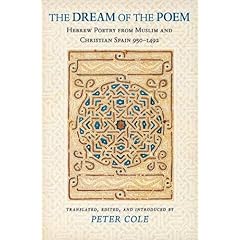
I don't know how many of you have already seen it, but there was a glowing review of Peter Cole's new anthology The Dream of the Poem: Hebrew Poetry from Muslim and Christian Spain, 950-1492 (Princeton UP) in the New York Times a few weeks back. Quoth Eric Ormsby:
One day in 10th-century Baghdad a visiting foreign student named Dunash Ben Labrat showed his teacher, the revered scholar Sa'adia Gaon, a poem he had composed in a novel style. Sa'adia handed the poem back with the comment ''Nothing like it has ever been seen in Israel.'' This dubious compliment, which all teachers of creative writing might wish to employ, failed to discourage Dunash. He took himself, and his new poetry, back home to Muslim Spain. There, despite the dismay his mediocre verses prompted in other aspiring Hebrew poets, his style caught on. Within a few decades, from these unpromising origins, a brilliant and original body of Hebrew verse began to take shape. Virtually stagnant since late Biblical times, Hebrew poetry and the language itself would be transformed by a succession of poets of genius and their imitators. In Peter Cole's rich new anthology, the extent of their astonishing achievement is fully revealed for the first time in English.
It's a beauty, this book, and I hear tell that even though Amazon says it will take 4-6 weeks to ship, they have them in stock. Find it somewhere, buy it, and let's talk!

Celan in Eric's Siddur

Norman Finkelstein

Despite my doubts about the project--Eric and I have had on an on-again, off-again debate about the uses of modern poetry in liturgy--I would say that given the hybrid nature of this strange beast, Paul Celan's work would be a must. One thinks immediately of his "Psalm" ("Praised be your name / no one"), from which comes the title of his volume Die Niemandrose (1963). But perhaps just as powerful and appropriate to the occasion is this untitled poem, also from that volume:

Your
Being beyond in the night.
With words I fetched you back, there you are,
all is true and a waiting
for truth.

In front of our window
the bean-plant climbs: think
who is growing beside us and
watches it.

God, so we read, is
a part and a second, a scattered one:
in the death
of all those mown down
he grows himself whole.

There
our looking leads us,
with this
half
we keep up relations.

This is the Michael Hamburger translation; the one by John Felstiner also has its virtues. The first stanza in particular has always struck me as a perfect expression of the modern Jewish religious sensibility.

Monday, May 28, 2007

Siddur Kol Hevel, part 2

Rachel sent a link to this, which Catherine Madsen (author of the essential, fascinating book on liturgy, The Bones Reassemble) drafted some years ago:
Our father, our king, we resent fathers and kings.
Our mother, our teacher, we resist mothers and teachers.
Our eclipse, our no-one, renew us for a good year.
Our figment, our construct, hear us, pity us, and spare us.
Our guess, our denial, seal us in the book of pardon.
Our hope, our dismay, speed our liberation.
Our doubt, our division, temper us to your need.
Avinu malkeinu, for your sake if not for ours.
Our limit, our secret, remember us 'til we live.

Our rock, our redeemer, give us endurance in pain.
Our place, our midst, root us in the cracks of your being.
Our breath, our life, evade all our theologies.
Our midwife, our surgeon, bring out of us what is in us.
Our infant, our patient, demand from us 'til we provide.
Our lover, our consoler, lie down beside us in loneliness.
Our enemy, our catastrophe, goad us to act justly.
Our mugger, our rapist, shatter our lives with your claims.
Our maker, our destroyer, build us again from the ground up, carefully.
That's more specifically liturgical than I had in mind for SKH (Siddur Kol Hevel), Rachel, although I'm very grateful! I'd been thinking of things like Blake's "All deities reside in the human breast" or scraps of verse, like Cohen's "I draw aside the curtain. You mock us with the beauty of your world" (from Book of Mercy). And I must say, much as I admire the first two lines here, I deeply dislike the penultimate one. Not to sound like Job's wife, but if you're going to call God a mugger and rapist, why not call him "Our Hitler, our Stalin," or "Our sondercommando" and be done with it?

This, on the other hand, also by Madsen, helped give me the title for my project:
For liturgy, God is always a moving target: we pray to him and get equivocal answers, or none; we ask to see his glory and are shown only his back. Any assertion we make of God's grace and mercy is at once undercut by the contingency of our daily experience. Any assumption we make of God's indifference or hostility is eclipsed by the appearance of mercy and grace in our lives. The declaration from the burning bush, ehyeh asher ehyeh ("I will be what I will be"), is a promise and a threat in equal measure, and hints at the simultaneous presence and absence of God at the other end of our prayers. Yet whether God is present or absent is not a final or even an answerable question, only a sort of spiritual brain-teaser by which our minds stay alert. With or without God, what is unequivocably present is the human other in need.
"Kol Hevel" is, after all, a pun: "all is vanity," but also "The Voice of Abel," which is to say, of your brother's blood, of "the human other in need."

But keep them coming, everyone! Show me what you're working with, as the (utterly inappropriate) song says.

Sunday, May 27, 2007

Siddur Kol Hevel

Eric Selinger

Hi, everyone. I've made the joke so often it's not funny anymore--which is to say, I am now officially working on Siddur Kol Hevel: A Prayerbook for the Rest of Us. Not a prayerbook, exactly: more a set of readings. Poems, tags of prose, you name it, all of them contrapuntal to normative Judaism, whether from a secular, heretical, philosophical, mystical, or literary point of view. Jews and non-Jews welcome: in this book, Blake rubs shoulders with Scholem, Duncan with Deutcher with Dickinson, the Kotzker Rebbe with Leonard Cohen and Marc-Alain Ouaknin. You get the picture.

What I need now is your help.

What are your favorite, most inspiring, most unsettling passages? The ones you turn to, or that shaped you, for better or for worse? Ones you've stumbled across, and that haunt you--or tickle you, for that matter, with their sass and heterodoxy.

I'll post mine, one by one, as the summer goes on. Please post yours, as comments or (if you're a contributor) as a post: the passage, and some sort of attribution, so that I can track it down if need be.

I don't know what all of this will end up being: a book, a website, who knows? But it's a project worth doing, I'm sure of that, and we're the folks to do it!

Wednesday, May 23, 2007

Poem By Heschel, Music by Pharaoh's Daughter

Woke up this morning...

...and realized I'd given that last post the wrong title.

It should have been

Min ha-matzav karati Yah--

A psalm from my Siddur Kol Hevel.

(Sorry.
Grumpy.
Time for
Coffee.)