Check it out.
Wednesday, July 22, 2009
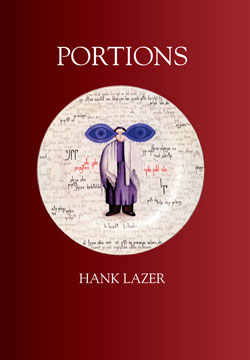
Hank Lazer's Portions
Check it out.
Thursday, June 18, 2009
New Issue of Shofar
SHOFAR
Vol. 27, NO. 3
Articles
Partisan Experiments: Communism, Poetry, and the Liberal Imagination,
1934-1940
Ethan Goffman........................................................................................................ 4
"Time to Translate Modernism into a Contemporary Idiom": Pedagogy,
Poetics, and Bob Perelman's Pound
Alan Golding.......................................................................................................... 16
Tracking the Word: Judaism's Exile and the Writerly Poetics of George
Oppen, Armand Schwerner, Michael Heller, and Norman Finkelstein
Burt Kimmelman.................................................................................................. 30
Jewish Counterfactualism in Recent American Poetry
Joshua Schuster................................................................................................... 52
Is There a Distinctive Jewish Poetics? Several? Many? Is There Any
Question?
HankLazer............................................................................................................. 72
A Portfolio of Poems
poetry and translations by Charles Bernstein and Kevin M. F. Platt, David
Epstein, Thomas Fink, Norman Finkelstein, Benjamin Friedlander, Arielle
Greenberg, Jamey Hecht, Michael Heller, Alan Holder, Burt Kimmelman,
Joseph Lease, Deena Linett, Bonnie Lyons, Stephen Paul Miller, Daniel
Morris, Alicia Ostriker, Warren Rosenberg, Steven P. Schneider, Daniel R.
Schwarz, Nikki Stiller, William Wallis, and Henry Weinfield........................ 91
Review Essays
American Jewish Poetry, Familiar and Strange Alicia Ostriker....148
Passing Through
Henry Weinfield.................................................................................................. 151
Book Reviews......................................................................... 156
Book Notes........................................................................... ...213
Monday, June 08, 2009
Wrap-Up & Teaser
It's Monday the 8th, and my quarter is over.
Not technically. Exams and final papers come in Friday, and I'll have to grade them. But the teaching and class prep are done, and the committee work as well.
What a year.
As you know, if you follow Say Something Wonderful and / or Teach Me Tonight, this has been a year of highs and lows for me.
The lows? Not getting my Promotion to Full Professor leads the pack--still a stinging, simmering disappointment--followed by assorted deaths of children's pets, angst over my son's Bar Mitzvah celebration, increasing ambivalence about all things Jewish, thanks in part to the Gaza war and in part (l'havdil) to mounting unhappiness with the religious school at my synagogue. In the end, we simply pulled our kids out--this after, what? Five or six years of work on various committees, trying to improve the curriculum. An utter failure, that, and I don't take failure well.
The highs? Well, let's see. Judaically speaking I'd list playing with the Alte Rockers right near the top, along with my son's Purim Bar Mitzvah, which defied any number of familial and communal expectations. Professionally, there were the conferences: first the Jewish Reconstructionist Federation in November, then, in the spring, in quick succession, the Popular Culture Association in New Orleans, then the big Princeton conference on Romance Fiction and American Culture, which got covered by the Huffington Post (among other media) and now the final push to prepare the international conference on Popular Romance Studies down in Brisbane, Australia.
And, most of all, there was the writing. Early in the year I ground out (slowly, painfully) a long essay on the poet Lawrence Joseph that will be coming out soon in the University of Cincinnatti Law Review. It's a good piece, and the foundation for future work on Joseph, whose work I highly recommend. From that I pivoted to write another essay, this one on three Palestinian poets, Mahmoud Darwish, Taha Muhammad Ali, and Samih al-Qasim. It will be coming out in Parnassus at some point in the next few months, and I'm doubly proud of it--as an essay and as a second essay, as it's been ages since I wrote more than one published piece in a single school year.
While you wait for that one to come out, here's a teaser--the opening paragraphs:
“The house is dark in the February damp, but when she opens the door to let me in, Imm Nizar is laughing.”
Stop, just a moment, to appreciate that sentence from My Happiness Bears No Relation to Happiness. Start with the pacing: three poised clauses, sight and touch yielding to motion, then sound. Savor how it’s knit by sound, as “dark” sets up “damp,” then “door,” then “Nizar,” in” modulates to “Imm,” and “damp” transforms into “laughing.” Most of all, thank Adina Hoffman, its author, for the way it beckons you into the daunting subject announced by her subtitle: A Poet’s Life in the Palestinian Century. At the start of what she claims is the first biography of a Palestinian writer “in any language (including Arabic),” Hoffman calls up laughter, not anger, hospitality, not guilt, and a domestic scene instead of the public saga of displacement, frustration, and war.
The poet she focuses on is an unlikely subject: the gracious, self-deprecating husband of Imm Nizar, eighty-seven-year old Taha Muhammad Ali. Given the fame he has recently accrued, reading with his translator, Peter Cole, to hundreds, sometimes thousands of fans at the Geraldine R. Dodge Poetry Festival, Muhammad Ali may be better known in English now than he is in Arabic. Born in 1931, he didn’t write a poem until the early 1970s, by which time Samih al-Qasim and Mahmoud Darwish, the two other poets I will discuss, were famous as rock stars. “How is it that we didn’t even know you existed?” the Iraqi author Buland al-Haydari demanded of Muhammad Ali a generation later. The explanation was simple enough: When they met at his first international reading, the poet had no political ties to make him famous, little distribution for his work, and, at fifty-seven years old, still only one slim volume to his name.
In centering her “group portrait” of Palestinian writers around a poet even she calls “marginal,” Hoffman borrows a strategy from the poet himself. “Taha has often likened his own poetic method to what he calls in English ‘bill-i-ar-des,’” she writes. “‘You aim over here—‘ a long, gnarled, yet delicately mottled farmer’s finger points to the right—‘to strike over there.’ The finger bends sharply to the left.” To use the technical term, both Muhammad Ali and Hoffman put considerable “English” on the course of Palestinian history since the 1930s, spinning it into useful, graceful, surprising trajectories. As a result, My Happiness Bears No Resemblance to Happiness offers the best introduction I know, not only to the poet at its heart, but also to the more famous authors who have crossed paths with him or spent years talking to him in the makeshift, under-the-radar salon of his souvenir shop in Nazareth. With it in hand, I have spent the past few months re-reading not only Muhammad Ali’s own work, but also Sadder Than Water, the recent Selected Poems from Samih al-Qasim (another Ibis Editions poet, in English) and, with blossoming admiration, the fine new crop of Darwish translations, which let American readers grapple, for the first time, with complete books by this expansive, reflective, mercurial, and self-revising poet. Not to slight the useful pair of monolingual Selecteds, The Adam of Two Edens (2000) and Unfortunately, It Was Paradise (2003), translated by various hands, but for Darwish, as we shall see, the collection was as much the unit of composition as the individual poem. Only now, thanks to translators Jeffrey Sacks and Fady Joudah, can readers without Arabic, including me, begin to take his measure.
More soon,
E
Monday, June 01, 2009
Dahlia Ravikovitch
I learn from the Forward that a Collected Poems of Dahlia Ravikovitch has come out from Norton, with Chana Bloch and Chana Kronfeld the translators. A long, rich review of the book--with lots of information about the poet--came out in Ha'aretz as well. Not, it seems, a bilingual edition, it's worth noting. When I get my hands on a copy, I'll post more.
(I wonder what course I could teach that would let me talk about this. Or should I not, since I don't have the Hebrew? But if I don't, who will--at DePaul, I mean? Decisions, decisions...)
Tuesday, May 26, 2009
Odds & Sods
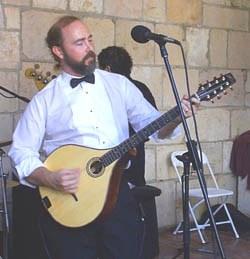
Here's a taste of the Alte Rockers in action, performing one of my own compositions: "You Shuckled (All Night Long)":
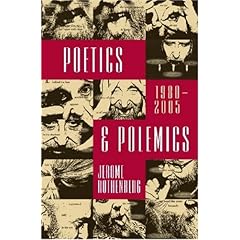
During this time, our own Jerome Rothenberg started a blog, Poems and Poetics, which I've added to the links list on the right. It's pretty amazing: like one of his anthologies evolving in real time. I've let it slide too long, but now have the pleasure of binging on it. You can, too!
Jerry also has a couple of new books out, both worth knowing. First, we have this:
The second book from Jerry is
Hmmm... No, that's too blurby, too abstract.
Let's be honest--I'm thinking about these books today because it was reading Jerry's Big Jewish Book back in '78 that showed me there was room for a scoffer, blasphemer, and heretic like me, not just at the margins, but at the heart of Jewish tradition. The uglier and more repressive the current Israeli government gets--Lenny Bruce! Thou shoulds't be living at this hour--, with the latest bill proposing to imprison those who provoke "scorn" for Israel as a Jewish-and-democratic-state (can someone give me the German for that compound? It feels needed), and the more disappointed I get in my children's former Hebrew school (I've pulled them both out for next year), the more I need another dose of that: something even stronger, more substantial, than the dose I can get from tugging on a "Jews for Asherah" trucker's cap. (Speaking of which, did anyone else read this piece in Zeek about Jews, Goddesses, and the Zohar? Not bad, but to me, old news--thanks to Jerry, first among many. Why does this stuff have to be re-discovered, decade after decade?)
Another new book came out, which I've yet to read: Yermiyahu Ahron Taub's What Stillness Illuminated / Vos Shtilkeyt hot Beloykhtn, a suite of five-line poems in English, Yiddish, & Hebrew "inspired by the poet's experience as an artist's model." You can find samples here, and they're not what you might expect from that description--looks like a mysterious, evocative book, and I look forward to getting my hands on it.
Months ago I read and enjoyed Things on Which I've Stumbled, by Peter Cole. Will get back to that and write about it; for now, a mention will suffice.
OK, petering out here, clearly. But it's nearly erev Shavuot, and I've wanted to get back on line here for a while. Let this post mark that return, even if it doesn't do any job particularly well.
More soon,
Eric
Friday, May 15, 2009
Anyone know...
My father was a god and did not know it. He gave me
The Ten Commandments neither in thunder nor in furry; neither in fire nor in cloud
But rather in gentleness and love. And he added caresses and kind words
and he added “I beg You,” and “please.”
And he sang “keep” and “remember” the Shabbat
In a single melody and he pleaded and
cried quietly between one utterance and the next ,
“Do not take the name of God in vain,” do not take it, not in vain,
I beg you, “do not bear false witness against your neighbor.”
And he hugged me tightly and whispered in my ear
“Do not steal. Do not commit adultery. Do not murder.”
And he put the palms of his open hands
On my head with the Yom Kippur blessing.
“Honor, love, in order that your days might be long
On the earth.” And my father’s voice was white like the hair on his head.
Later on he turned his face to me one last time
Like on the day when he died in my arms and said
I want to add Two to the Ten Commandments:
The eleventh commandment – “Thou shall not change.”
And the twelfth commandment – “Thou must surely change.”
So said my father and then he turned from me and walked off
Disappearing into his strange distances.
Friday, April 24, 2009
Monday, February 23, 2009
Allen Grossman Wins Bollingen Prize
Allen Grossman, one of the most important figures in the field of Jewish American poetry and poetics, has been awarded the Bollingen Prize. Here are the details. And here (scroll down) are three poems from Descartes' Loneliness. Congratulations, Allen, from the Big Jewish Blog.
The Jewish poet (the Jew's great poet whom I wish speculatively to summon to mind) is called monologically by Presence itself. The correlative but severely contrastive figure in traditional Jewish narrative to the gentile muse (daughter of Memory) is the Shechinah, whose name means dwelling--the dwelling of the name in the world: the Jew's place to be.
Allen Grossman,
"Jewish Poetry Considered as a Theophoric Project"
Sunday, February 01, 2009
The Music of Thought in the Poetry of George Oppen and William Bronk
The Music of Thought in the Poetry of George Oppen and William Bronk, by Henry Weinfield, has just been published by the University of Iowa Press. I can't really write a review here, since as Henry notes in his Introduction, Steve Fredman and I spent "considerable time and effort...reading and commenting on the manuscript of this book at every stage of the process." I can, however, give you my blurb: “Henry Weinfield’s The Music of Thought is a penetrating study of two of the most significant American poets of the second half of the twentieth century. The author implicitly demonstrates that modern poetry, which for some has been overshadowed by other literary genres and recent developments in the media, still speaks to the central concerns of our society. After reading this book, one can see that poetry still counts. This is an essential book for the study of modern poetry.” Better yet, here is a remarkably perceptive passage from Henry's discussion of Oppen's most famous poem, "Psalm":
Oppen's "Psalm" is a genuine poem of praise for our time, not merely a sentimental effusion, and in an Age of Irony, such as we continue to inhabit, to have written a poem of praise that does not offend the intellect is a considerable achievement. Oppen's God has the decency not to exist (or, like Spinoza's Deus sive Natura, to exist only as nature), and for this reason we cannot very well accuse him of being wicked or uncaring. Oppen is thus the antithesis of a gnostic, and in the light of the Shoah it is not so easy to evade gnosticism. The world of Oppen's poem is not a fallen or an intrinsically evil world; nor, in the context of the world, do we as human beings have to resort to the doctrine of original sin to get God off the hook...Oppen's "Psalm" reconciles us to realities and enables us to live in the world.
The centerpiece of this wonderful book consists of two lengthy readings, one of Oppen's long poem Of Being Numerous, and the other of all the major poems in Bronk's Life Supports. So pardon me if I repeat myself: an essential book.
Monday, January 19, 2009
New Member's Greetings
I'm just signing in, so to speak. I'm delighted to be a part of this group.
Best wishes,
Burt
Friday, January 16, 2009
Eschaton, by Michael Heller
Michael Heller’s last two books of poetry, Wordflow (1997)and Exigent Futures (2003), are both volumes of new and selected poems, with some degree of overlap between them. So it is particularly exciting to have this collection of all new work—and what a beautiful book it is! An austere black-and-white production from Talisman House, decorated with the abstract drawings of Heller’s friend, the late sculptor Bradford Graves, Eschaton (the word, according to the OED, refers to “the divinely ordained climax of history,” as in “eschatology”) is a further chapter in the quest for the “difficult freedom” (to borrow from Lévinas) which for Heller constitutes poetic wisdom. This wisdom, half-Jewish, half-Buddhist, is found in spite of oneself, as in the opening couplet of the title poem: “I don’t know where spirit is, / outside or in, do I see it or not?” It is wisdom which comes to Heller through his dedication to cultural tradition, to everyday life, and to the careful turns of language that have always made his poetry such perfectly measured work.
At all points, it is a matter of responsibility. “One tries pulling syllables clean, like freeing / old nails from plaster” he notes in “The Chronicle Poet. And later in the same poem: “Useless, useless! Nothing / impedes thought’s passage more than an unuttered word, / one desperately cut short or untimely enough to have become stuck / where it makes only a shameful noise…” To avoid the stuck word, the unuttered word, Heller will take extraordinary risks. Often eschewing lyricism almost entirely (and here he remains true to his Objectivist heritage), he seeks instead “To find words as a kind of meeting place / even as they fly loose in unresisting air” (“From the Notes”). The poem, then, is an act of community, but still a gamble, a risk that may just as well come to naught. “How to put world there, at word-brink” he asks, “among so many lovely things that flow?” (“At Word-Brink”). It is there, in that flow, that the poet may find what he is looking for, but lose it as well.
One of Heller’s most important answers to this problem is found in the title of one of the last poems in the book: “Commentary Is the Concept of Order for the Spiritual World.” Here, as in a number of other important poems in the book, Heller reasserts the principle of commentary which, through many years of sustained practice, has made him one of the most important Jewish poets of our time. Commentary offers us “the salvaging uncertainties / in the world’s overriding syntax” (each line of this poem has a dramatic, signifying space, an emptiness in the center). Commentary both links us to tradition and sets us off on our own. This accounts, I think, for Heller’s extraordinary grace when it comes to reference, allusion and quotation in his work. He accepts that his poetry is a fold in a great conversation of commentary, that linguistic “meeting place” in which he posits his faith. And it is in this humble belief, inspiring his practice, that Heller’s poetry paradoxically achieves its magisterial power.
Monday, December 22, 2008
In Memoriam
Tomorrow is my birthday; today, a sunny cold afternoon, I stand at the computer, crying for a woman I didn't know.
"Except for its marauding hand--"
--EMS
Tuesday, December 16, 2008
Two New Books of Interest
Wednesday, December 10, 2008
Catching Up
Started with my own rabbi's blog, Shalom Rav, which has been tracking his trip to Iran. Sounds like quite a journey for him, and one that makes me proud (again) to be at JRC. When I picked up my daughter last night, he motioned me over, wanted to talk Hafiz & Persian Poetry. Can we swap in some of that for the Marge Piercy & Rami Shapiro in the next edition of Kol Haneshama? No offense to MP and RS, but Hafiz is world-class work.
Ah, but what translation? That's the kicker, in't? Take a look here--the "Songs of Hafiz" website --and tell me if any of them strike you as liturgy-ready. My hunch is no, alas, so we're back to square one.
***
I spent a fair while over at the the Velveteen Rabbi, whose detailed account of the Rabbis for Human Rights conference was both fascinating and encouraging. (Note to self: do NOT read comments on Ha'aretz articles. They depress you, cut you off at the pass. The comments, not the articles. When tempted, read VR instead.)
***
Josh Corey, a youngish Jewish American poet (i.e., younger than I am) is in a slough of sorts, at least according to his blog:
Caught in the feedback loop of silence. Wanting to write—there's no more futile emotion. You have to want to write something. And I am writing, here and there, but it never seems like the thing. But wanting it to be "the thing" is what defeats me.He goes on to quote an "astonishing passage" from Louis Hyde's introduction to a collection of essays by Thoreau:
A Thoreauvian prophetic essay leads us on a redemptive journey... but there is a redemption of the valley as well, one that comes from abandoning all hope of getting it together. If you need to come apart, you do not need to listen to the prophetic voice. Stop trying to be a hero. There is a time to fall to pieces, to identify with the confusion of your life as it is, confined absolutely to the present November sunset and your present apartment. (Emphasis added.)And responds:
This is exactly what I needed to hear, exactly the cure for the itch of objectless ambition, or more simply the desire to "get it together": to seamlessly synthesize a life that, in its multiple spheres—writing, new fatherhood, marriage, teaching—resists all my efforts to be glued into a whole. If I can take Hyde's advice and be an upended Thoreau, who goes not into the woods but deeper into his own messy life, maybe I'll find my way back to the writing that matters to me, without letting everything else go any more to pieces than it already is.Good luck & God speed, Josh, as they say. If you read this, and have some ideas, send them his way.
More catching up tomorrow, I hope, and slowly--ever so slowly--I'll make my way back to poetry per se. (If you're reading, say hello! I could use the Shamu'ing.)
Eine kleine exit music, please!
Monday, December 08, 2008
Two Cheers for Chrismakah?
Dear ---,A teaching moment for my kids, at least. I had a blast, on the way to school, talking my daughter through the things we'd have to cut from holidays in order to make them "purely" Jewish. (First step, scrap the Passover seder. Symposia are echt goyisch, non?)Thank you for your message about "Chrismakah." The decision of which holiday to celebrate, and how, and when, is a very sensitive and difficult question for interfaith families. Certainly Eric and I have gone through plenty of arguments and unhappiness over this, and most of the other mixed couples we know have had similar difficulties.I feel fortunate that Eric is now willing to celebrate Christmas with me. We have been married for 20 years, and there was a time when any expression of Christmas was very uncomfortable for him. For some couples, celebrating a Christian holiday at all is simply not an option because it would make the Jewish partner extremely unhappy. Eric, for example, was raised with a deep-seated aversion to anything related to Christmas, and it has taken him decades of marriage to get past that.This aversion is much more common than you might think. For couples who face it, a "Chrismakah" celebration may be the only way to find a middle ground. It defuses what would otherwise be an explosive conflict in the house, and can be a very helpful step towards having an actual celebration of both holidays.This year, Chanukah and Christmas fall on the same day, and in our household we plan to celebrate them both at the same time by observing Christmas according to my Catholic faith, and by lighting Chanukah candles for the Jewish members of the family. We agree with you that this is the best way to celebrate in a mixed family. But if other interfaith households find that having a "Chrismakah" celebration lets them avoid quarreling over what to do for the holidays, Eric and I--and our children--think that this may actually be a very good thing indeed.With appreciation for your dedication to the kids at the religious school,---
Syncretism gets a bad rap, says I. Or, to quote the poet (Ogden Nash): "Purity / is obscurity."
Sunday, December 07, 2008
Bar Mitzvah Blues (1)
It's about three months away, and I must confess, the thought fills me, not with joy, but with deep disappointment. Anger, even.
Clearly I'm going to have to get over this by the time March rolls around, and indeed much sooner. But as long as I'm blogging, I might as well tell the truth.
***
My own Bar Mitzvah was a joke of epic proportions. I went into it eager to write a D'var; the rabbi, a pompous wretch, explained that he, not the boy, wrote the commentary. All I had to do was deliver it. I had no idea what the words coming out of my mouth meant; the service meant nothing; even the presents, aside from my first guitar (thanks, Uncle Fred!) were a disappointment. Coffee table books about Hawai'i, where we lived at the time. A few bonds. (Can you tell I'm still bitter?)
***
One good anecdote: guests from the mainland, at the Sunday brunch after, heaping their plates with sashimi, thinking it was lox. Not a bad metaphor for the whole process, I'd say, but I like sashimi too much to insult it that way.
***
But it's not the memory of my own Bar Mitzvah that sours me on my son's. What does? First off, I'd say it's disappointment. For years I tried to improve the religious school at my synagogue. I worked on the school committee; I wrote curricula; I intervened when my son got bored. None of it, I am sorry to say, made any lasting difference. Things are as bad now as they were six years ago, at least as my children report it to me. The religious school director who got sacked two years ago never managed to get buy-in from the teachers for the most interesting changes, which means that they've just kept chugging along doing what they've always done. And that's just not good enough.
One year, one of seven, was different. Last year he came home excited, wishing the classes were longer. He stopped doing the pullout extra Hebrew, joined the main class, loved the discussions (ethics, Jewish American history, etc.) . I helped one of his teachers write a curriculum unit on Jews and the counterculture in America, which he loved.
That experience sent him into this year's class eager to pick up where that left off. Oops. New teacher, oversized class, no classroom management, dull topics, no focus, complete disaster. "Looks like they've totally given up teaching us Hebrew," says he--this when, two years ago, he was starting to work with a college level textbook in pullout sessions.
It took me years to get over my own wasted time in supplementary school. I really thought I could spare my children that, but I haven't been able to, and that galls me.
***
Day school? Don't make me cry. I'm in an interfaith marriage, and I'm not sending my kids to a school where they'll be taught--directly or by implication--that their parents' marriage is a bad thing.
This means that I have to be my children's primary Jewish teacher. Which was fine with me, and I happily did, for many years. Then something happened. What? And how do I get it back in the next three months?
I'll post on that as this series goes on. Need to talk myself out of, back into something, and I don't have a whole lot of time.
***
Oh--here, to keep this relevant, a poem. Leonard Cohen, from Book of Mercy:
All my life is broken unto you, and all my glory soiled unto you. Do not let the spark of my soul go out in the even sadness. Let me raise the brokenness to you, to the world where the breaking is for love. Do not let the words be mine, but change them into truth. With these lips instruct my heart, and let fall into the world what is broken in the world. Lift me up to the wrestling of faith. Do not leave me where the sparks go out, and the jokes are told in the dark, and new things are called forth and appraised in the scale of the terror. Face me to the rays of love, O source of light, or face me to the majesty of your darkness, but not here, do not leave me here, where death is forgotten, and the new thing grins.
Friday, December 05, 2008
Stray Thoughts
***
Dinah writes: "I look forward to hearing more from you about prayers and poems -- especially how verse form affects the use and meaning of prayers, and about the inner poetic structure of the Psalms."
Gosh, I don't know much about either of these, Dinah.
The closest I can come on the former ("how verse form...") is to say that when I was a boy, the Mourner's Kaddish had such complete authority of sound that I didn't care what it meant, phrase by phrase. I knew the general sense from the English version on the facing page, and that was enough to tether my flight. This became the model for how I read Cummings, then "Prufrock," then Pablo Neruda's Versos del Capitan and the Residencia poems, my first loves in the art.
For me it's not the verse form that's significant in connecting poetry & prayer, but the imaginative projection that one does in reading verse. Take the poem, I tell my students, as a script for you to say; the same holds true for the siddur. This is why I sometimes flinch at my rabbi's suggestion that we ignore the words of, say, the Amidah & "pray what's in our hearts." The script can be used to unlock things "in our hearts" that we didn't know were there--associations, emphases, sudden insights--and as a means of self-transformation. Pouring out the heart can do the same, but it also can stay entirely superficial, just as rote as any fixed prayer-form. Especially when everyone's watching their minyan-mate from the corner of their eye, trying not to be the last one standing:
Shacharit is going fastAs the boys of Green Day sing, or would.
But that guy wants to make it last
Wake me up
When the Amidah ends...
(I'd like that even more as a Yom Kippur parody. "Wake Me Up When Neilah Ends.")
--Time to wake the kids. More anon.
Tuesday, November 25, 2008
Zukofksy: Scroggins' Lecture On Line
If you missed Mark Scroggins' fine lecture on Zukofsky as a Jewish modernist at the Spertus Institute--and you know you did!--you can find it on line, now, thanks to the kind archivists of the Poetry Foundation. Take a gander, or a listen anyway, here. (Bouzouki, alas, not included).
Monday, November 24, 2008
Milosz
Spent too much of the afternoon working on lyrics for a couple of new Alte Rockers songs. Counting down to Purim; "Good Jews Don't" and "(Talkin' 'bout) My Congregation" in the works right now. Oh, and "Bright Jews," the old Bob Seger fave.
Here are the next two poems from the JRF session last weekend, by Amichai and Milosz.
Amichai, "God’s Fate"Comments always welcome--and questions.
God’s fate
is now like the fate
of trees and stones, sun and moon,
in whom people stopped believing
when they began to believe in him.
But he must stay with us:
at least like the trees, at least like the stones
and like the sun and the moon and the stars.
Milosz, "On Prayer"
You ask me how to pray to someone who is not.
All I know is that prayer constructs a velvet bridge
And walking it we are aloft, as on a springboard,
Above landscapes the color of ripe gold
Transformed by a magic stopping of the sun.
That bridge leads to the shore of Reversal
Where everything is just the opposite and the word 'is'
Unveils a meaning we hardly envisioned.
Notice: I say we; there, every one, separately,
Feels compassion for others entangled in the flesh
And knows that if there is no other shore
We will walk that aerial bridge all the same.
Friday, November 21, 2008
Poetry and Prayer
I'm not even going to try and explain why this blog has been silent for so long. Maybe I should simply have retired it when the going got tough--it seems that blogs have a life-cycle, although writing that phrase instantly brings to mind the idea of blog life-cycle events (brit milah, Bar Mitzvah, etc.), and I really don't want to go there.
Anyway, now that fall quarter is more or less done, I might as well give this another go, and it just so happens that I have some material to post. Last weekend, you see, I was off at the Jewish Reconstructionist Federation's biannual convention in Boston, on a panel called "Why Do We Pray? Continuing the Conversation about Reconstructionist Liturgy." My colleagues on the panel were Rabbi Eric Caplan (author of From Ideology to Liturgy: Reconstructionist Worship and American Liberal Judaism) and Catherine Madsen, whose book The Bones Reassemble: Reconstituting Liturgical Speech you need to know if you have any interest in liturgy as a language-art. (She also writes the best parodies of progressive liturgy I've ever seen, which is an art in its own right.) Dan Cedarbaum, past president of the JRF, was the convener and chair.
My contribution? A sheaf of poems, by Jews and others, that struck me as useful in thinking about what prayer is and what poetry can teach us about it. I read a few out loud and talked about them, and I figure I can post those up here, a little at a time, to get myself back in the habit of blogging again.
The first ones I spoke about come from the Amichai sequence "Gods Come and Go, Prayers Remain Forever," in Karen Alkalay-Gut's translation, which I found on line in The Drunken Boat. I used numbers 1, 3, and 9, but really only talked about 3, and the core insight (Amichai's and others') that prayer precedes theology, and that poems about prayer remind us of the need--at once vulnerability and desire--that lies behind, or comes before, the rituals and creeds and other products of the God-making imagination.
("Out of deep need," as Zukofsky says somewhere. Yes?)
Anyway, here are the Amichai poems that were in that little handout. The rest you can now click over to, and if you have any thoughts (about these or about the Hebrew originals, what's lost in translation, whatever), let me know!
1.
On the street, one summer evening,
I saw a woman writing words
on paper unfolded on a locked wooden door.
And she folded it and put it between the door and the mezuzah and went away.
And I didn't see her face nor the face of the person
who would read the note,
and I didn't see the words.
A stone rests on my desk with the word "Amen" written on it.
It is a piece of a tomb, a vestige from a Jewish cemetery
destroyed a thousand years ago, in the city where I was born.
One word, "Amen," is cut deep into the stone—
A hard and final Amen for all that is past and will not return,
a soft and melodious amen like a prayer.
Amen and amen, and may it be His will.
Tombstones break, words pass, words are forgotten,
lips that uttered them turn to dust,
languages die like people,
and other languages are resurrected,
gods in the heavens change, gods come and go.
Prayers remain forever.
3.
I say with perfect faith
that prayers precede God.
Prayers created God.
God created man,
And man creates prayers
that create God who creates man.
9.
The Jewish people read the Torah to God
all year long, a chapter a week,
like Sheherezade who told stories to save her life,
and by the time the Celebration of the Torah comes around,
He forgets and we may begin again.
Translated by Karen Alkalay-Gut